

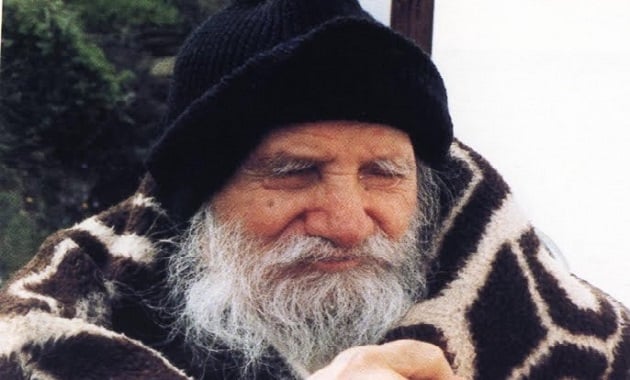
In Wounded by Love, we read how the remarkable 20th century mystic and miracle-worker, St. Porphyrios, warned against certain pitfalls that over-zealous Christians often fall into and which deflect focus away from Christ. Even spiritual occupations that have a place in the Christian life, such as meditating on death or focusing on our own sinfulness, can distract the soul from union with Christ and His love.
Here are St. Porphyrios’s warnings on how over-thinking about death and judgement can distract the soul from Christ.
“I don’t think about death. Whatever the Lord desires. I want to think about Christ. And you too, open your arms and throw yourselves into Christ’s embrace. Then He lives within you. And you constantly think that you don’t love Him very much and you want even more to come close to Him and be with Him. Show disdain for the passions and don’t concern yourselves with the devil. Turn to Christ. For all this to happen it is necessary for grace to come: ‘The divine grace which ever makes good what is weak and supplies what is lacking…’
There are many other ways, for example through remembrance of death, of hell and of the devil. Thus you avoid evil out of dear and through counting the cost. In my own life, I have never employed those methods which are exhausting, cause a negative reaction and often produce the opposite of the desired effect. The soul, especially when it is sensitive, is filled with gladness and enthusiasm through love; it is strengthened and transforms, alters and transfigures all the negative and ugly things.” [Wounded by Love, p. 112 & 137-9]
This is similar to the method used by the seventeenth-century Catholic monk, Brother Lawrence, whose life and teaching have come down to us in the remarkable little book, The Practice of the Presence of God. A simple monk in seventeenth-century France, Brother Lawrence transformed all his work—whether chores in the kitchen, work repairing sandals, or a journey to purchase wine—into opportunities for prayerful communion with Christ. His life became so radiated in what St. Porphyrios calls “divine eros” that he found it unhelpful to think about death and judgment. He did not even dwell on whether he was going to heaven or hell since “whatever happened to him would be according to God’s will, so he was not at all worried about it.” His only desire was to be in the presence of Christ, a goal he fulfilled by talking to Him constantly.
When our goal is to live every moment in Christ’s love, then just as worrying about judgment can become a distraction, so can preoccupation with our own faults. Focusing on our faults, though it has its place, can become a dangerous distraction, especially for people suffering from overscrupulousness or morbid introspection. We may even forget that the sacrament of confession is precisely so we can let go of our sins (even besetting sins that we continually repeat), not dwell on them. Again from St. Porphyrios:
“God has placed a power in man’s soul. But it is up to him how he channels it – for good or for evil. If we imagine the good as a garden full of flowers, trees and plants and the evil as weeds and thorns and the power as water, when what can happen is as follows: when the water is directed towards the flower-garden, then all the plants grow, blossom and bear fruit; and at the same time, the weeds and thorns, because they are not being watered, wither and die. And the opposite, of course, can also happen.
It is not necessary, therefore, to concern yourselves with the weeds. Don’t occupy yourself with rooting out evil. Christ does not wish us to occupy ourselves with the passions, but with the opposite. Channel the water, that is, all the strength of our soul, to the flowers and you will enjoy their beauty, their fragrance and their freshness.
You won’t become saints by hounding after evil. Ignore evil. Look towards Christ and He will save you. Instead of standing outside the door shooing the evil one away, treat him with disdain. If evil approaches from one direction, then calmly turn in the opposite direction. If evil comes to assault you, turn all your inner strength to good, to Christ. Pray, ‘Lord Jesus Christ, have mercy on me.’ He knows how and in what way to have mercy on you. And when you have filled yourself with good, don’t turn any more towards evil. In this way you become good on your own, with the grace of God. Where can evil then find a foothold? It disappears!…
Do not choose negative methods to correct yourselves. There is no need to fear the devil, hell or anything else. These things provoke a negative reaction. I, myself, have some little experience in these matters. The object is not to sit and afflict and constrict yourself in order to improve. The object is to live, to study and to pray and to advance in love – in love for Christ and for the Church.
What is holy and beautiful and what gladdens the heart and frees the soul from every evil is the effort to unite yourself to Christ, to love Christ, to crave for Christ and to live in Christ, just as Saint Paul said….
Forget about all your weaknesses so that the adverse spirit does not realize what is going on and grab you and pin you down and cause your grief. Make no effort to free yourself from these weaknesses. Make your struggle with calmness and simplicity, without contortion and anxiety. Don’t say, ‘Now I’ll force myself and I’ll pray to acquire love and become good.’ It is not profitable to afflict yourself to become good. In this way your negative response will be worse. Everything should be done in a natural way, calmly and freely. Nor should you pray, ‘O God free me from my anger, my sorrow, etc.’ It is not good to pray about or think about the specific passion; something happens in our soul and we become even more enmeshed in the passion. Attack your passion head on, and you’ll see how strongly it will entwine you and grip you and you won’t be able to do anything.
Don’t struggle directly with temptation, don’t pray for it to go away, don’t say, ‘Take it from me, O God!’ Then you are acknowledging the strength of the temptation and it takes hold of you. Because, although you are saying ‘Take it from me, O God’, basically you are bringing it to mind and fomenting it even more. Your desire to be free of the passion will, of course, be there, but it will exist in a hidden and discreet way, without appearing outwardly… ” [Wounded by Love, 135-7]

His analogy of the weeds is one I’ve used before in the context of parenting. Many parents think that good parenting involves fussing over a myriad of tiny things, like a gardener obsessively going after all the weeds. But a better approach (which I’ve discussed elsewhere here and here) is to focus on cultivating healthy and mature plants that eventually have the strength to deal with the weeds themselves. Sometimes a skilled gardener needs to know when to attack a weed head-on, but equally he knows when tackling the weed runs the risk of injuring the plant. It’s the same with parenting, and also with ourselves. If a certain besetting sin is getting you down, St Porphyrios gives you permission to stop obsessing about it and gently turn your attention to Christ. Again from Wounded by Love:
“We can attain to the worship of God easily and bloodlessly. There are two paths that lead to God: the hard and debilitating path with fierce assaults against evil and the easy path with love. There are many who chose the hard path and ‘shed blood in order to receive Spirit’ until they attained great virtue. I find that the shorter and safer route is the path with love. This is the path that you, too, should follow.
That is, you can make a different kind of effort: to study and pray and have as your aim to advance in the love of God and of the Church. Do not fight to expel the darkness from the chamber of your soul. Open a tiny aperture for light to enter, and the darkness will disappear. The same holds for our passions and our weaknesses. Do not fight them, but transform them into strengths by showing disdain for evil. Occupy yourself with hymns of praise, with poetic canons, with the worship of God and with divine eros.” [Wounded by Love, p. 136]
Further Reading
- How We Are Raising Fragile Children, Why Pain isn’t Always Bad, and How Healthy Activities Protect us from Addiction
- How to Deal With Intrusive Thoughts
- Transforming Over-Sensitivity
- Remaining Tranquil
- The Cross of Least Resistance
- Letting Go of Troubled Thoughts
- Pain is an Opportunity for Spiritual Growth
- Our Thoughts and Mental Health: an Orthodox Perspective
- Why Over-Control May Prevent Your Prayers Being Answered
- The Power of Baby Steps in a Superman Culture
- Use Positive Self-Talk to Overcome Anxiety