

I wanted to let everyone know that my publisher, Ancient Faith, is putting on a 50% off sale for both my books. But just for one day! Mark your calendars for Friday March 6th, when you can buy both Gratitude in Life’s Trenches and Rediscovering the Goodness of Creation at half off their normal price.
This sale only works if you phone their store (800-967-7377) or order from the Ancient Faith website on March 6. If ordering from their website, here are the relevant links:
- Gratitude in Life’s Trenches: How to Experience the Good Life. . . Even When Everything Is Going Wrong
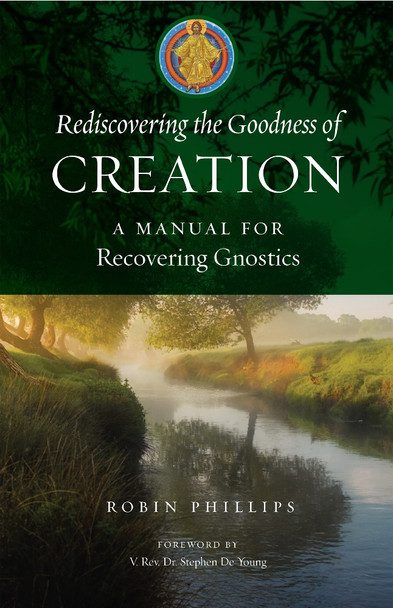
- Rediscovering the Goodness of Creation: A Manual for Recovering Gnostics
I wrote Gratitude in Life’s Trenches to offer tips, strategies, and exemplars on practicing contentment in the midst of life’s ups and downs. But this isn’t your average self-help book written to help miserable people feel better. On the contrary, I show that genuine gratitude enables us to lean into the darker side of life. From chapter 8:
Sentimentalism fails to confront the reality of pain in our world through an escapism in which everything becomes rosy. Like a Thomas Kinkade painting, sentimentalism presents an overly simplistic worldview with no framework for understanding the darker and more complex side of human experience. It offers us a shortcut to happiness that bypasses genuine joy by numbing away our capacity to feel suffering, vulnerability, and pain.
Cynicism, on the other hand, recognizes what is wrong but also offers no context for understanding it, no framework for being able to see purpose and meaning in the hard providences God sends our way. To the cynic, evil becomes a type of cruel joke. While the sentimentalist is numbing himself to pain, the cynic looks evil in the eye and despairs.
Some people who are not tempted by sentimentalism or cynicism will nevertheless succumb to the temptation of stoicism. Stoicism offers the false promise of being able to remain unmoved by circumstances that would normally lead to emotional suffering. This philosophy provides a psychological buffer against the impact of pain by offering an escape from the realm of unpleasant feelings. Stoicism was popular in the Roman Empire and exerted an influence on some of the Church Fathers. For example, Origen of Alexandria (184–253) taught that grief is not an appropriate emotion for a Christian to feel. In his On First Principles, Origen raises the fact of Christ’s apparent emotional agony at Gethsemane (Matt. 26:36–46) as a problem in understanding the theology of the Incarnation. Like the monk Jorge in The Name of the Rose, who insists that Jesus could never have laughed, the stoical Origen is clear that Jesus could never have grieved. Accordingly, the great Alexandrian went to great pains to assure his readers that Jesus only began to grieve but stopped short of actually grieving.
All three of these false philosophies—sentimentalism, cynicism, and stoicism—effect a hardening in us, a tightening of the heart, a process of emotional numbing. All are defense mechanisms that offer a false path of escape from painful feelings like vulnerability, shame, insecurity, and emotional wounds. Other common ways of emotional numbing include:
- substance abuse
- making reactive choices in response to our pain
- rationalizing our pain away, as if we could think ourselves out of suffering
- comfort eating
- displacing uncomfortable emotions (e.g., vulnerability, shame, insecurity) with unhealthy emotional substitutes like blame, anger, or judgment)
- inner vows never to let ourselves become vulnerable again
- projecting an exterior of bravado and toughness, as if to say, “I’m the sort of person who can never be hurt.”
Gratitude is the answer to sentimentalism, cynicism, stoicism, and other defense mechanisms, for it releases us to lean into our pain with a courageous vulnerability. Gratitude releases us to stand face to face with the pain, ambiguity, and complexity of life and not to despair. Gratitude empowers us to embrace the frailty, weakness, and pain around us while remaining at peace.
Here’s why: when we use gratitude to reframe our sufferings, we are not denying that the suffering is taking place, nor are we painting an escapist gloss over our difficulties. Rather, we are choosing to perceive the larger context in which the suffering occurs: a context that provides occasions for gratitude regardless of what is happening around us. Insofar as gratitude enables us to lean into pain, to be realistic rather than escapist, it provides the resources to be there for others who are suffering, instead of insulating ourselves from their pain as a form of self-protection.
Once again we see how different gratitude is from escapism and false optimism. Gratitude gives us the power to look pain straight in the eye and to be at peace instead of despairing. It gives us the ability to derive genuine enjoyment from small blessings even when evil, suffering, and pain are crowding in on us. Gratitude gives us the power to dare greatly, with a courageous vulnerability that is able to stand up after defeat, striving valiantly for what is most meaningful to us.
This is important not simply so we can weather life’s storms, but so we can have the inner resources to engage with others who are going through hardships. Instead of pushing people away because we cannot cope with their pain, or numbing ourselves in order to be insulated from other people’s grief, a grateful person has the inner capacity to empathize with those who are in pain and, as the apostle said, “rejoice with those who rejoice, and weep with those who weep” (Rom. 12:15). In our comfort-oriented culture, it has become second nature
to avoid those who are suffering or lonely, or whose lives are messy and filled with pain. People are desperately hungry for acceptance, understanding, belonging, and empathy, and when these are not available, our society offers all the equipment they need for numbing themselves.The problem is that we cannot selectively numb emotion. When we make ourselves invulnerable to the emotional impact of pain, then we inadvertently numb away our capacity to feel love, joy, empathy, and thanksgiving. When we harden ourselves as a defense against fear, grief, disappointment, shame, rejection, or vulnerability, the result is that we also reduce our capacity to feel the emotions that are important for well-being.
As for my other book, I wrote it to counter the matter-spirit dualism so prevalent in modern anti-sacramental Christianity with roots in 16th century Calvinism. But Rediscovering the Goodness of Creation isn’t just an attack on contemporary Christianity; I also walk through salvation history, showing that God’s covenant was always about the renewal of the space-time universe. This positive eschatological vision offers a way to lean into death and pain without despair, even as gratitude offers a way to reframe the experience of suffering. From chapter 15:
A person who has begun to experience theosis can even perceive beauty in death, knowing that resurrection life begins breaking into our world through death.
The reality of death means that all experiences of beauty in this world are transitory, like flowers that blossom in the sun only to wilt and die. We have encounters of true joy through the beauty of art, music, and friendship, but these are episodic and, even at their best, leave us longing for something that lies beyond the reach of the present age. Through these encounters, we glimpse something eternal—something that remains even after death and vanity have had their say and after we have turned to dust in the ground. A language beyond mere words assures us that there is a deeper magic that will one day subsume us. Even as creation groans in bondage, every flower, every sunset, and every work of beauty whispers to us of that coming finale our present experience so tantalizingly points toward, and toward which all creation groans in hope.
The promise of eschatological joy, when we will be joined to the fountainhead of all beauty, is the hope lesser degrees of beauty point to. That is why spiritual sensitivity to beauty will always cultivate a sense of holy discontentment that refuses to be satisfied with anything but God Himself. As we saw in part 6, we should see the manifestation of what is beautiful in creation as an icon of eternal good, truth, and beauty, but it is only an icon; we can only find the reality these qualities point toward in the happy vision of God. Thus, the most moving poetry, the loveliest music, the most beautiful literature, will always leave us slightly unsatisfied, for the best art always points beyond itself, awakening deep yearnings that echo the joys awaiting us in the new heavens and the new earth.

Anti-gnostic polemics are nothing new in the 21st century, and are often touted the loudest in worldly forms of Christianity, where countless individuals have been all to ready to take St. Irenaeus misquoted maxim, “the glory of God is man fully alive,” as justification for treating the world as a banquet of pleasurable experiences. As I observed in chapter 16,
Christian communions drifting toward worldliness and hedonism have been quick to latch onto the goodness of the world, but with a shrunken doctrine of goodness disconnected from order and coherence. As such, modern Christianity has often merely followed the cultural zeitgeist, which makes an idol out of the body while also rebelling against the body and its internal order. For example, liberal Christianity often defends actions that bring spiritual harm to the body (i.e., immorality, immodesty, and various forms of sexual experimentation) precisely under the banner of being body-affirming. This inconsistency became possible when our concept of “the good” became untethered from the idea of the real (which is to say, disconnected from any truth about the good), thus collapsing goodness into subjectivism. Within such a scheme, to say “creation is good” amounts to little more than saying, “I like the world.” The material world thus becomes so much raw material that we can create meaning out of through pleasure-seeking activities or through rendering the world useful toward functional ends.
In answer to this hedonism, I draw on the metaphysics of St. Augustine of Hippo and St. Gregory of Nyssa, both of whom argued that the very reason we can rejoice in all that is good, true, and beautiful on earth is because it participates in the primal goodness of God. This acknowledgement, in turn, offers an important limitation on attempts to treat terrestrial goodness and beauty as the final human telos. As such, the very affirmation of the goodness of creation is tied to the practice of asceticism. Here’s how it works, from chapter 12:
Understanding God as the archetype for all that is truly good and beautiful helps contextualize the problem of sin. For the Church Fathers, sin is a misdirection of our longings, like a lover who becomes so entranced by a portrait of his beloved that he does not notice that she herself has come into the room. In one of his poems, C. S. Lewis—a thoroughgoing Augustinian—illustrates this teaching with the example of a bee caught buzzing at the window pane. The bee thinks she sees the way to the flowers and grass on the other side of the window, yet if left to her own devices she will finally die. Only by submitting to what seems a kind of death—someone catching the bee in a handkerchief and taking her outside—will she reach the freedom she longs for.
The distorting influences of sin continually lead us away from our primal longing for God’s beauty, as finite goods promise an original goodness or intrinsic beauty. But at best, these finite goods are meant to kindle a desire for the fullness of what they possess only in part. Ultimately, human love and beauty signify something beyond the confines of earthly experience, pointing us to the age to come when we will be resurrected to enjoy perfect union with God and each other in the new heavens and new earth. C. S. Lewis revisited these primordial longings in his sermon, “The Weight of Glory.” He movingly described the desire we all feel that no earthly experience can satisfy but which so much of our experience hauntingly portends: “We do not want merely to see beauty, though, God knows, even that is bounty enough. We want something else which can hardly be put into words—to be united with the beauty we see, to pass into it, to receive it into ourselves, to bathe in it, to become part of it.” In the same sermon, Lewis went on to suggest that this desire will ultimately find fulfillment when we inhabit our glorified bodies. “What would it be,” he asked, “to taste at the fountainhead that stream of which even these lower reaches prove so intoxicating? Yet that, I believe, is what lies before us. The whole man is to drink joy from the fountain of joy.”
Because our temporal longings for earthly goodness and beauty are instances of our primal longing for eternal goodness and beauty, they can beguile us with the illusion of possessing life in themselves. The practice of asceticism, even when we practice it reluctantly, offers us the chance to reorder our affections because it helps us focus more directly on the eternal longing for God, the ultimate source of temporal longings. Through activities such as temperance, chastity, fasting, and practicing the virtues, we redirect ourselves away from the objects of our short-term desires and realign with the true object of our desires.
I’ll end with some interviews and further resources on both these books.
- Peter Biles’ Review of Rediscovering the Goodness of Creation
- Ancient Faith Today: Podcast with Robin Phillips & Dr. Phillip Cary on Rediscovering the Goodness of Creation
- Joshua Pauling’s Touchstone review of Rediscovering the Goodness of Creation
- Dylan Pahman review for the Acton Institute of Rediscovering the Goodness of Creation
- Path to The Academy Podcast on Rediscovering the Goodness of Creation
- Introduction and first chapter of Gratitude in Life’s Trenches free at Issuu
- Interview with Ancient Faith about Gratitude in Life’s Trenches
- What others are saying about Gratitude in Life’s Trenches
- Interview with Holistic Christian Life about Gratitude in Life’s Trenches