
An edited and slightly longer version of this article is now available at my Substack.
In Greek mythology, King Midas of Phrygia once performed a great service to the god Dionysus by finding the latter’s schoolmaster and foster father, Silenus, after the aged satyr had gone missing. In gratitude, Dionysus promised Midas anything he wished. Greedy for wealth, the king asked that anything he touched be henceforth turned to gold.

Initially King Midas was delighted at his newfound ability, experimenting on an oak twig and a stone. But upon finding that food on his banquet table turned to gold before he could taste it, he began to regret the choice. In Nathaniel Hawthorne’s retelling of the myth, Midas reached out to embrace his daughter only to find himself holding a golden statue.
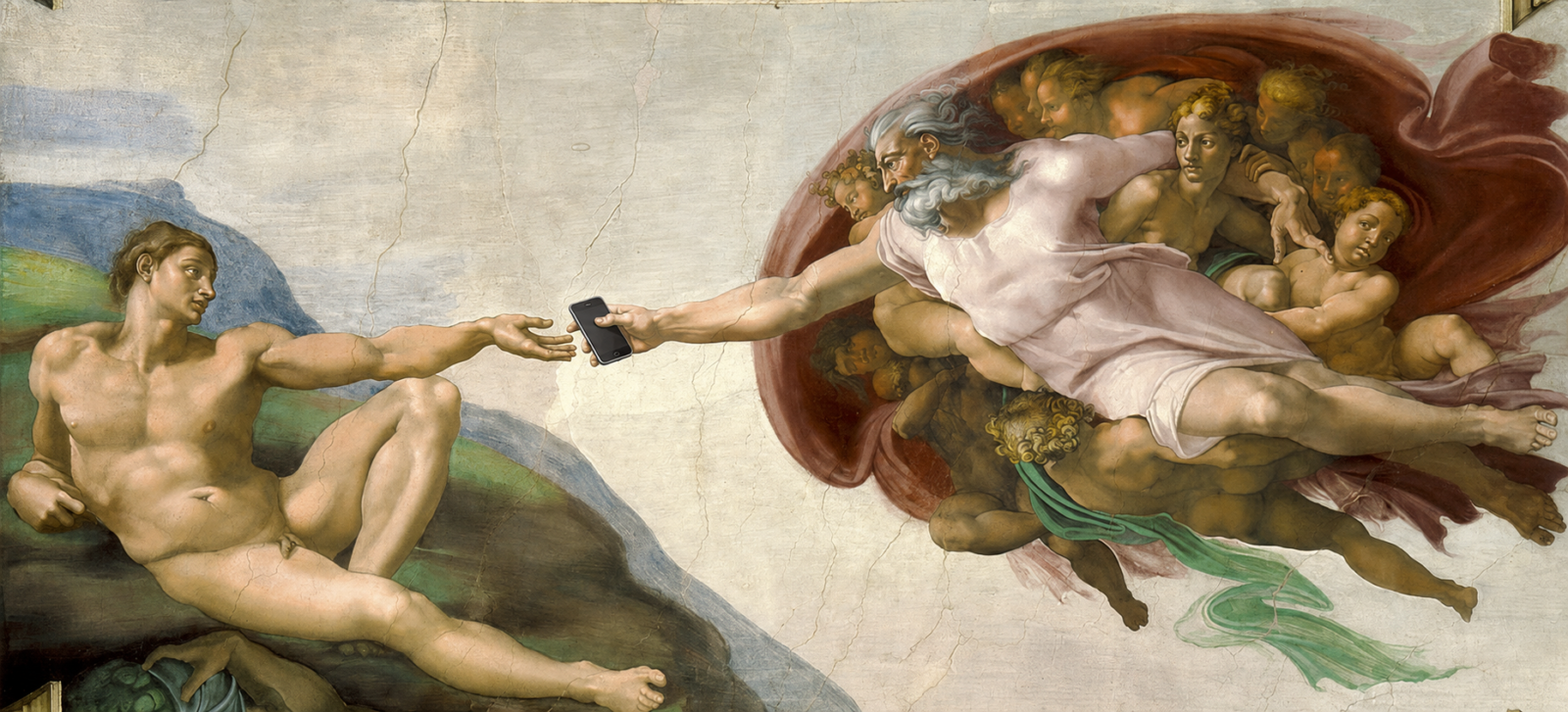
The Midas myth is a fitting analogy for the destruction of language currently happening in real time. LLMs offer a type of linguistic Midas Touch, putting at human fingertips unprecedented wealth and power. Any of us can now harness, aggregate, synthesize, combine, and recombine, the linguistic power of the entire internet and to put that power to the service of whatever communication need we happen to be facing. Not even King Midas, for all his greed, could have conceived such power. Even if he had filled the entire Mediterranean with libraries, schools, and scriptoria, and filled them with scribes furiously working around the clock at pattern recognition—not even then could he have achieved the data-processing capacity at the disposal of a simple 13-year old with a basic laptop and internet connection. Our medieval forefathers conceived of turning base metals into gold, but not even in their wildest dreams of a Philosopher’s Stone did anyone conceive of wealth that might result from turning electricity into knowledge.
But maybe we should stop to ask whether, in our techno-utopian rush to harness the wealth of language, we might actually be killing it.
To understand how LLMs offer a type of linguistic Midas Touch, we need to understand how language works over time. In one of his books (I can’t remember which, but I think it was Cultural Literacy), E. D. Hirsch reflected that the core condition of language has been one of permanent flux. All the anthropological and historical evidence points to the fact that language has never been static but constantly changing. If people from one village leave and start a settlement a hundred miles away, it takes only a few generations before not only their accent, but the language itself changes, undergoes significant alterations. Add a few centuries, with the normal influence of migrations, war, etc., and you’ll have enough organic lexical change and grammatical restructuring that a completely new language comes to exist. This is why, in the early stages of British colonization in America, Australia, South Africa, etc., thinkers predicted that in a hundred years the inhabitants of each of these lands would be speaking a new form of English incomprehensible to the others.
That never happened with English, and the reason is obvious: mass literacy and print distribution effectively froze the English language. The fact that we can still read and understand Shakespeare is amazing. Sure, people don’t speak Shakespearean English anymore, but it’s clearly recognizable as the same tongue. The linguistic differences that separate us from the 16th century are not nearly as great as the differences that separated 16th-century English speakers from their Old English predecessors some six hundred years earlier.
But while English has remained relatively constant, we still enjoy all the beautiful variations of style from one English writer to another. But the graces of style, and all the wonderful idiosyncrasies, have been partially smothered through word processing tools that freeze English—at least partially—in the bland sterility of “correct” style. Consider the platform Grammarly, which does more than merely identify spelling and grammar mistakes, but introduces rigid syntactical uniformity. Grammarly and similar tools function like an over-eager English major patrolling prose with a sense of syntactical superiority. When researchers have put text from Austen, Dickens, and Shakespeare into Grammarly, the algorithm flags their prose as technically incorrect. Unfortunately, as more students defer to Grammarly as the standard, the result is a prescriptive uniformity that overrides nuanced stylistic choices. This becomes self-reinforcing because as more Grammarly-assisted content makes its way into print, and therefore into the minds of readers, these publications reinforce the Grammarly style.
If this was a problem with Grammarly, it is multiplied a hundred-fold now that LLMs are doing content generation for an increasing number of writers (not to mention that Grammarly is now integrated with Azure OpenAI Service, so that the editing tool now suggests entire sentences and paragraphs of AI-generated prose). Consider that much of what now exists as policy manuals, professional documents, emails, website content, Substack articles, college essays and discussion posts, was rewritten by an LLM prior to publishing. Rather than copying content into an LLM and asking it to list grammar mistakes as bullet points for the author to then review and selectively correct, it is common to simply ask the LLM to rewrite the whole thing, meaning the final published document is in the AI style. Each time an author does this, he adds to the growing corpus of English texts that further reinforces that style. When enough people do this, the result is that the corpus of English publications starts to have the sterility of sameness and predictability.
In fact, predictability is how these systems work: impervious to meaning, they merely predict the next most probable token. As more of this AI-generated content becomes what people read on websites, documents, emails, etc., it begins to self-reinforce itself as “the King’s English,” so to speak – the canonical way that English ought to be spoken. This doesn’t happen all at once – it will take decades of saturation in AI-generated content before the machine’s style begins to feel fully “correct,” but there is significant evidence that this process is already well underway. Frequent exposure is normalizing the AI style, making it seem correct and authoritative. This is creating self-reinforcing loops that favor polished, middle-of-the-road global English over and against more human-sounding prose. Because this is happening largely beneath conscious awareness, it is hard not to be swept up in this style freeze, especially if we are not actively reading large amounts of good literature.
But that isn’t even the worst news. More than simply nudging language into the sterility of uniformity, AI could standardize thought itself. Here’s what Talbot Brewer warned in Hedgehog Review when discussing LLMs.
Their stochastic parroting gives to their pronouncements a seductive simulacrum of authority—the authority of reigning opinion, the authority of the herd. Now that we can access this authority with the push of a button and undetectably attach our name to it, claiming it as our own, will we continue with the struggles that it promises to spare us from? Or will we be seduced by the frictionless-ness that is both the design ideal of the virtual realm and the central element of the technology sector’s operative notion of the human good?
The term “stochastic parroting” refers to language-generation based on probabilities, and comes from Sam Altman who suggested in a tweet that probability-based parroting is the essence of language.
i am a stochastic parrot, and so r u
— Sam Altman (@sama) December 4, 2022

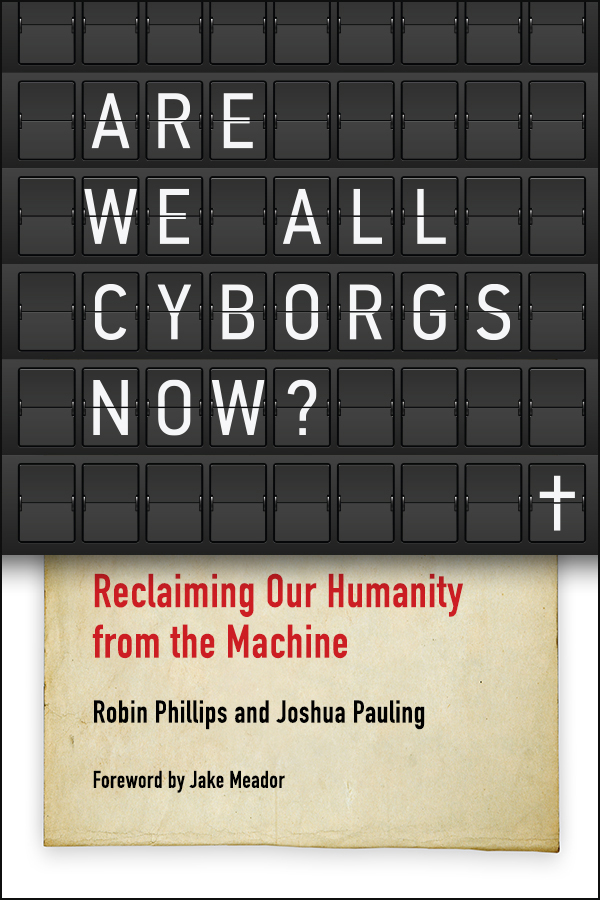 It’s hard not to perceive in Altman’s words the very feedback loop that Joshua Pauling and I warned about in our 2024 book Are We All Cyborgs Now? We suggested that as humans make the machine in our image, we actually end up existing in the image of the machine, setting up machine-human feedback loops that risk turning us into psychological cyborgs. This machinification of humans is happening at rapid speed in the one gift that marks us as distinctly human: language. The power LLMs give us over the world—the Midas Touch of being able to craft the perfectly “correct” communication—ends up turning our very language into something as lifeless as a gold image. Although Mr. Altman justifies this by suggesting that the LLM approach to language is all language is anyway, the implications of this cynicism are profound. Because language is the context of human thought, what is at stake is nothing less than human rationality itself. This is one of the ominous take-home points in Brewer’s piece at the Hedgehog Review already referenced. Brewer went on to offer the following warning in his essay, “The Word Made Lifeless Are we becoming stochastic parrots?“:
The quest for words is a crucially important driver of this continuous emergence toward being. As we bring our thoughts to words, we give to ourselves a more definite and concerted identity. This too is sometimes audible, and even visible. There is a difference between a speaker who is reading a paper without thinking the thoughts being articulated and a speaker who is having the thoughts expressed by his words. In the latter case, you can hear the speaker gathered up and enlivened by his speech. This is what fresh and truly fitting words do: They awaken us. They reenact the uncanny event of the quickening of clay.
Matters are quite otherwise with the new text generators we have so recently brought into our lives, and to which we now delegate a rapidly growing share of our quest for fitting words. If we can speak of thinking here, it is thinking of a wholly different kind. These new entities have no still-hazy intimations of their own that their words might either crystallize or bastardize. There is no possibility of felt urgency in their quest for words, none of that nearly erotic excitement we humans feel when we finally have the thought we have been groping for. They have no pangs of conscience when their words sound shallow or cliché. Indeed, cliché is their special strength: They cleave to the center of gravity of the vast sea of human-generated texts, finding each new word by predicting what human beings would most likely say. They have nothing of their own to say, no life from which they might say it, nor any soul or self their words might fashion or disfigure. They are, as it has aptly been put, stochastic parrots.
It would be a brazen slander for anyone to add: and so are we, as Sam Altman did in a 2023 tweet soon after the release of ChatGPT: “i am a stochastic parrot, and so r u.” Such words could emerge only from a willful forgetting of the lived experience of being human and of seeking to say something worthwhile to fellow humans. No one speaking to his own child in a moment of despair, or to his spouse in a moment of marital reckoning, could consciously aim for faithful mimicry of the patterns laid down by past generations of fellow mimickers. To hear yourself, suddenly, as speaking in this way would be to lose all faith in your capacity to rise to the occasion….
Pretend for a moment that you’ve been granted the enormous memory and data-processing capacity of the new generation of large language models (LLMs). You could then adopt and hold yourself to the standard of successful word choice that they use. Actually, we don’t have to pretend: We can already ensure that our words are meeting this standard simply by letting the LLMs choose them for us. It is obvious that we could not pursue any worthy ideal of speech while applying this suddenly available method. There is, after all, only an occasional coincidence between the word that is the most probable successor to a string of already-written words and the next word required by any worthy ideal, including unflinching lucidity. This should come as no surprise. It takes only a moment’s serious thought to see that stochastic parroting is utterly beneath us.
Or, at any rate, I hope we see this. Yet this insight might prove fragile. As Iris Murdoch once wrote, “Man is a creature who makes pictures of himself and then comes to resemble the picture.” We should keep this in mind when we assess Sam Altman’s declaration that we are all stochastic parrots. If we were to internalize this picture of ourselves, we might slowly release our attachment to whatever aspirations and ideals are obviously at odds with it. We would then be living more faithfully in accordance with the self-conception recommended by certain enthusiasts of “human-level” AI. Which is to say, we would be busy dying.
The common come-back to these concerns is that all technology causes certain skills to atrophy. We no longer have skills at driving a horse and buggy, but we accept that as part of the cost for greater efficiency. All technology comes with a trade off, and LLMs are no different. I don’t accept this argument. It is true new inventions weaken or render unnecessary former abilities, but what are the abilities that LLMs weaken? It is our rational powers. It is one thing to lose the ability to drive a horse and cart, quite another to lose the ability to think and communicate rationally and beautifully, both of which are central to our very humanity. As the word becomes lifeless, so do we.
Further Reading