

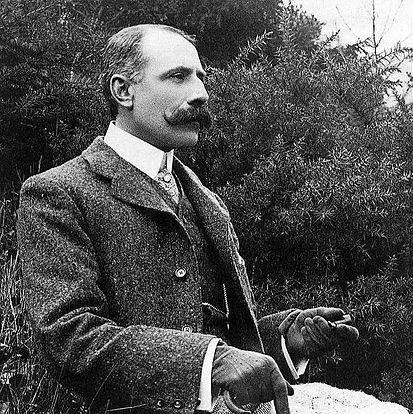
When I lived in England, everyone loved and talked about the music of Edward Elgar (1857-1934). Elgar is right up there with George Frideric Handel among the island’s musical luminaries (and we don’t talk about the fact that Handel, like the House of Winsor, was originally German). So imagine my surprise when I moved back to America and found that very few people—even classical music lovers—had ever heard of this remarkable composer.
Elgar was a product of his time, with a career that straddled the twilight of romanticism with the dawn of modernism. Technically he falls within the period of twentieth-century music, but his style drew inspiration from more melodious nineteenth-century models. That is one of the reasons his music is timeless even as the experimental twentieth-century music is quickly becoming passé.
In Elgar there is a confluence of the innocence characteristic of the Victorian period in which he grew up, with the proud masculine sophistication—even, at times, ostentation—of the Edwardians, combined with the melancholy of knowledge and loss enjoyed by those who survived the Great War. Even when his music is at its most heartbreakingly sweet, it is always tinged with manly restraint and subtle melancholy. It is romanticism without gush, beauty without sentimentalism, manly pride without bravado.
Elgar’s Cello Concerto in E Minor, written in the aftermath of the Great War, seems to embody a painful longing for a bygone age. It is a complex amalgam of melancholy and triumph, surrender and imperialism, longing and acceptance, lyricism and dissonance, ostentation and innocence. In this work, it is almost as if we can hear the mature composer longing for the simplicity of an earlier era (an era embodied in the innocent charm of his Salut d’Amour) but with the painful knowledge that his world has been forever changed. The composer likely felt that the British empire (for which his triumphant “Pomp & Circumstance” is the paradigmatic work) was in its twilight, but even in this work the melancholy is juxtaposed with triumphant defiance—a sort of “do not go gentle into that good night” that the British have mastered so well. It reminds us that the British “stiff upper lip,” far from stifling emotional expression, allows for a greater range of expressiveness, even as restraint in love allows can allow for a more delicate range of subtlety.
I have listened to this work dozens of times (including two live performances), but it is still full of surprises me, and it still brings tears to my eyes. My favorite movements are the first (Adagio – Moderato) and the third (Adagio).
In 1994, Yo-Yo Ma performed this work with the Baltimore Symphony Orchestra. This was Yo-Yo Ma at his best. Enjoy!
Further Resources