

On May 21, 2023, the crowd of tourists at the Notre Dame cathedral in Paris France witnessed a brutal sight: an elderly man went up to the altar and shot himself in the mouth, his brain debris splattering everywhere among the 1,500 visitors. This was, of course, the suicide of Dominique Venner (age 78), influential ideologue of the French far-right. Protesting same-sex marriage and Islamic immigration, Venner described his death by saying, “I believe it is necessary to sacrifice myself to break with the lethargy that is overwhelming us,” adding, “I am killing myself to awaken slumbering consciences.” His death referenced the old Roman virtues embodied in many of the Stoics, who often killed themselves rather than endure the ignominy of defeat.
Venner was not a Christian; rather, he looked to Europe’s pagan past for civilizational ressourcement. An identitarian who believed races were locked in intractable conflict, Venner’s heroes were Faust and Prometheus — fitting icons for someone seeking to restore Europe to a vitalist ethos centered on the strongman and the creative force of human aggression. Venner’s bloody suicide stunt at the altar of Notre-Dame de Paris, a final act of protest against liberalism, encapsulated the despair of the radical right and their rejection of a polis based on sacramental ordering. But even in his rejection of sacramental ordering, Venner tacitly recognized the power of the Mass/Divine Liturgy. His suicide showed a nascent understanding—as visceral as it was unconscious—that the symbolism of the Mass somehow lies at the center of culture. Venner didn’t blow out his brains at Palais Bourbon, the legislative chamber of the French Parliament, nor did he go to the Beaugrenelle, Paris’s famous shopping mall, a fitting symbol of the nouveau régime. He understood that the altar is the seat of power, and he sought to harness this symbolism, even if he couldn’t fully understand why.
Venner’s empty sacrifice at the altar of the True Sacrifice points to a larger problem of the ressourcement of pagan political modalities: after the Incarnation, there can be no going back to the glories of paganism, whether the pre-Christian virtues of the old Roman statesmen like Cicero, or the martial virtues romanticized by Homer and now emulated in the publishing phenomenon, Bronze Age Mindset. These are no more accessible to us now, in their original forms, than is pre-Christian Judaism. David Bentley Hart makes this point so well in his essay “Christ and Nothing“: with the death of the old mythos at the incarnation, everything was transformed, so that a resuscitation of pre-Christian religion, metaphysics, spirituality, or politics, is more than merely anachronistic; it is nihilistic. The cross of Christ has swallowed up, not only all that was ugly and base in the ancient world, but all that was beautiful and glorious, so that only within Christendom can we truly celebrate what was good, true, and beautiful in our pre-Christian past, whether the martial virtues  of the Homeric warrior, the austere nobility of the Stoics, or the melancholy grandeur of the Norse, etc. Again, read DBH’s essay.
Christianity preserves the glories of the ancient world, not merely in a practical sense (insofar as Christianity has always put a premium on the type of liberal arts education that holds the ancients in high regard), but in the sense that only in Christianity can the glories of the ancient world remain glorious. To pursue pre-Christian heritage apart from the Christian faith—to try, for example, to approach Odin and Thor as did our Norse ancestors, or to emulate the noble suicide of the Roman stoics, as did Venner—is to recover, not the vitalism of our ancestors, but only a boring perversity and a depressing nihilism. In Christ’s sacrifice, a new era was launched upon the world, with the consequence that it is only in and through His work—including the ongoing reenactment of Christ’s death in the Sacrifice in the Mass—that we can have a meaningful past or a meaningful feature. It is also only in Christ that we can have a genuine culture instead of an anti-culture.
This means that if there is to be significant cultural renewal in our own era, the only engine that can drive that renewal forward is the Mass, or the Divine Liturgy as it’s called in the East.
Recently I have been reflecting deeply on the power of the Mass as the seat of cultural renewal, especially in the wake of the annual Touchstone conference. Last week I shared links to some of the fantastic talks at this year’s gathering. It’s interesting, and hopeful, that each year the speakers at Touchstone circle the same important questions, which are basically variations on one central question: what is the proper framework for us, as Christians in the 21st century, to think about the renewal of culture? To wrestle with this question, conference themes have ranged from the Benedict Option, to discipleship in a secular age, to Aaron Renn’s negative world thesis, to a variety of other templates for conceptualizing cultural engagement, with thinkers offering strategies from cultural pessimism to eschatological optimism to a qualified Christian Nationalism. It’s an important question, because the template for understanding Christianity’s relation to culture will impact the how and why of cultural engagement. At these year’s conference, we had one speaker who thought Christian civilization is a bad idea (though that was not the topic of his actual presentation), but most people within the Touchstone ecosystem think that Christendom is a good thing, and they hope for Christian civilizational renewal, yet struggle to find a unified conceptual landscape in which to situate the hope.
Leading up to this year’s conference, my pastor, Fr. Patrick, invested a lot of time teaching me about the Eucharistic model of cultural renewal. We even went on a retreat near the George Washington National Forest, along with three other men from the parish, to analyze and debate the notion that the Eucharist is the engine that drives cultural renewal. So during the Touchstone conference I kept wondering if any of the speakers would land on this theme. A number of presentations came close, skirting the edges, or offering notions that were adjacent, supplementary, or ancillary to the idea that the Mass drives cultural renewal. Some offered proposals that implicitly assume, but never made direct, the notion that the sacrifice of the Mass is the heart of culture. Because no one quite hit the bull’s eye, the speakers often reached for frameworks internal to the landscape of contemporary discourse, which resulted in occasional false dichotomies, sometimes in revolutionary ideologies, but usually in genuine insights that nevertheless lack a full sacramental context in which to situate those insights.
We don’t usually think about the Eucharist in the categories of culture and politics, while the theologians who have been trying to move the discourse in that direction—I’m thinking of the so called “radical Orthodoxy” movement that was all the buzz in the early 200s—tend to be deeply anti-incarnational, which is a total oxymoron. I’m convinced, however, that the best way to explain the Eucharistic model of cultural renewal is to start at the very beginning.
Consider, when God made Eden, he was creating a temple in which heaven and earth intersected. One of the reasons we know this is because Genesis 1 has all the literary features of an Ancient Near East temple construction narrative. And what was the function of temples in the Ancient Near East? They were places where heaven and earth interconnect. And what do you put in temples to help connect heaven and earth? You place in images in the temples. Significantly, after God created the garden-temple of Eden, He placed his images into the temple as the means for connecting heaven and earth. Men and women were to be a boundary or frontier between God’s space (symbolically, up there) and earth’s space (symbolically, down here). As priests of the garden-temple, mankind was given the job of lifting the earth toward heaven, and then acting as God’s vice-regents to turn the rest of the world into paradise. That’s what the cultural mandate of Genesis 1:28 is all about – taking what is true in the garden temple, and then implementing that throughout the rest of the world through the dominion of godly stewardship, creativity, and expansion. The beautiful reality of God walking and talking with Adam and Eve in the garden empowered them to spread out and multiply (both numerically and geographically), transforming the entire earth as God’s image bearers. (For more information about the temple symbolism of Eden, and how that relates to the image-bearing vocation, see the first section of my article on technology for The Symbolic World and my video on the redemptive-historical narrative that I made for my theology class.)
Man forfeited his high priestly vocation, and paradise was not extended throughout the earth. But when the image of God was restored in Christ, so was the human vocation to connect heaven and earth. After the ascension, Christ’s body now becomes the point of intersection between God and man, heaven and earth. So when His blessed body is made present to us in the Holy Mysteries, paradise is restored and, like Adam and Eve in the prelapsarian state, we are empowered to spread this beautiful reality throughout the earth, transforming the world, implementing the “as in heaven, so on earth” reality. That’s where the renewal of culture comes in. However, saying that the Mass empowers us to transform the world is not to say, “have communion on Sunday and then God will achieve civilizational renewal along the itinerary of existing templates for cultural improvement.” On the contrary, the Mass not only gives us the power to change the world, it also shows us how properly to think of that renewal, and the means whereby that renewal is achieved. It is achieved like this: through the Holy Mysteries, God’s healing presence flows outward in concentric circles from the parish until eventually the nations themselves are discipled, as Jesus told us to do in Matthew 28:19-20. When enough nations are discipled, you have the larger culture we call Christendom, with the blessing of cultural Christianity (which is to say, the leavening work of Christianity on the wider culture). That is why our vision can be nothing less than taking back the empire, as Fr. Patrick Cardine declared last year in his discussion of Christian triumphalism with Kyle King.
But the nations cannot be discipled without communities centered around the Eucharist, just like a body cannot function without a heart. A Eucharistic community is not like a Starbucks drive-through where we receive communion and then leave, expecting God to do the rest, and somehow magically transform culture in the process. That is a superstitious way of approaching the sacraments. We have to actually get busy working to make the sacramental life flow out into all the nooks and crannies of our community. Making and preserving culture is hard, since it involves making sacrifices for the community – everything from volunteering one’s time, to helping each other financially, to overlooking sins. It means that, even though we are scattered by the isolating effects of modernity, we must do our best to make the parish function like a village. What the town center used to do for a community, now the church does, as people loiter after Mass or meet at church for community events. That takes work just as it took work for Adam and Eve to take dominion of the earth. However, if we want Christendom renewed and invigorated, it starts here on the local level – very locally as Christ is made present to us in the sacrifice of the Mass.
When the priest elevates the Sacred Host, we celebrate the paradox that is folly to the power structures of this world, namely that crucified love is how the sons of Adam regain their home.
Lift high the Cross, the love of Christ proclaim,
till all the world adore his sacred name…
Saved by this Cross whereon their Lord was slain
the sons of Adam their lost home regain.
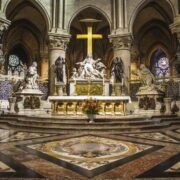
But even as the cross is lifted high, the devil is lifting high the anti-sacramentalism of worldly substitutes. Think the Tower of Babel, which was an attempt to re-establish sacred space and bring heaven down to earth. When we understand Babel in the context of Ancient Near Eastern ziggurats, it emerges that Babel was an anti-economy, a surrogate Eden by which man attempted to take dominion of the earth, prevent disintegration, and achieve greatness. While Babel was a rejection of the Edenic vocation, it was also an attempt—as are all utopias—to recreate Eden. Through the worship of fallen angels masquerading as gods, the people hoped to recover the order and power of sacred space and the lost security of the antediluvian world. Today we are trying to build the tower of Babel all over again. I don’t refer to Ken Ham’s attempt to build a physical tower of Babel (to be distinguished from the ideological tower of Babel he constructed long ago); rather, I’m referring to the data centers going up around us, and the inverted sacramentality on which the order of The Machine now hinges. If you’re attentive to what the architects of this new order are saying, they literally believe they can re-establish sacred space and connect earth with heaven in an electrical paradise. This is the Dark Mass that C.S. Lewis so presciently foresaw when he wrote That Hideous Strength.
Lewis’s book, which offered a fictional narrative that sticks closely to the theological framework of St. Augustine’s City of God and St. John’s Apocalypse, also offers hope. In Revelation chapters 17 through 20, St. John describes a final showdown between the followers of the Lamb vs. the Babylonian spirit, the latter personalized in the hideous strength of a false prophet, antichrist, and the kings of the earth and their armies — the final gasp of the city of man. With the city of God and the city of man having grown concurrently like wheat and tares, the final judgment against the city of man (Babel) is an apocalypse (lit. unveiling) as the people of God are called out from her (Rev. 18:4). Then judgment is issued against the beast system. This sets the stage for the great reversal of Babel and fulfillment of Pentecost that we read about in Revelation 21, namely the descent of the New Jerusalem from heaven making all things new (renewed). This new city is characterized by true justice, order, peace, and the common good. But here’s the exciting bit: this apocalyptic vision, though situated in the future, is clearly meant to order our lives, communities, and nations today. In the Church, the author of Hebrews reminds us, we can begin ordering our lives toward the heavenly Jerusalem, which is already a reality for those of us who are in Christ (Heb. 12:22–24). But what does it look like to live in the city of God prior to this final judgment? That brings us back to Lewis’s novel, and ultimately to the power of the Mass.
 In That Hideous Strength, Lewis shows how, within every nation, there is a subversive element—a logres, a city of God—that functions behind the scenes to resist the spirit of the age and secretly undermine the forces of darkness. This subversive element works, not primarily through fighting or mobilizing alternative sources of human strength, but through men and women forming communities centered around the love for God and each other—communities of healing that show a different way of being human. As the conflict between the New Jerusalem vs. the Babel is played out in Lewis’s narrative, his solution is that the heavenly city has been inaugurated now in the community at St. Anne’s through faithfulness in the humdrum activities like Mother Dimble faithfully saying her prayers, putting up with each other’s weaknesses, eating and drinking together—in short, functioning as a sacramental community, a true garden-temple for which the technocratic Tower of Babel was but a parody.
It is worth saying again: the false sacramentality of Babel can only be defeated by true sacramentality, namely the Eucharistic communities that emerge out of the Holy Mysteries (chiefly but not exclusively, baptism and the Mass). It is in Christian community, and multiple micro-civilizations centered around the sacraments, that we undercut the utopia of the Machine, the rising hegemony of Wokeness (whether the woke-left or the woke-right), the rising domination of Islam, or the dehumanizing effects of industrial capitalism.
It is this sacramental model of cultural renewal that, I fear, the anti-Christendom and anti-cultural-Christianity crowd miss. This movement to problematize civilizational Christianity is picking up momentum since Paul Kingsnorth’s Erasmus lecture nearly a year ago, and it isn’t hard to understand why: people are reacting against the woke-right, toxic forms of Christian nationalism, or models of cultural change that are unrealistically top-down or power-driven. I’m not entirely unsympathetic with this trend, as I think self-critique is always healthy. But I can’t help notice how the anti-Christendom polemicists rarely talk about parish life, nor the pedestrian duties of supporting Eucharist-centered-micro-communities through Christian education, art, music, poetry, marriage counseling, accountability partners, reading and prayer groups, etc. If we want to talk about Christian civilization, that is the sort of thing we should be talking about. True Christian civilization is not what the media would have us believe: it’s not about J.D. Vance, Tucker Carlson, and the toxic-apparatus of the woke-right machine. Rather, Christian civilization is about communities of healing that proclaim, through word and sacrament, a different way to be human than what’s on offer from industrial capitalism; it’s about communities who live out the principles of the Good Samaritan; it’s about communities of life that stand against the culture of death propagated by Planned Parenthood; communities of love and acceptance that stand against the weaponization of race foisted by the media and politicians; communities that show different models of manhood and womanhood than the tropes centered around pride, power, self-interest, and individualism. It’s a way of being human centered on the paradox of the cross—a paradox that is made present every day in the Sacrifice of the Mass.
Ok, I’m going to end with a shameless appeal. I hope to use my Substack to share some of the research Fr. Patrick and I have been doing on a Eucharist-shaped model of cultural renewal, and although I have an outline for seven articles of this topic that I want to roll out over the next year (all of which will hopefully become the basis of a book), the research is expensive and takes time away from my other income-generating activities. You can help support this work by taking out a subscription to my Substack. Subscriptions range from $5.00 a month to $500. The goal is eventually to grow the donor base until the Substack is bringing in $50,000 a year, so I can devote myself full time to putting out articles on Eucharist-shaped cultural renewal, and being more involved in some exciting work to incarnate these realities in my own community (more on that later!). So far the annualized income for the Substack is at $1000, so we have a long way to go with your help! I also use my Substack to report on cultural events, with it being the continuation of what I used to do for my Salvo column, but with more freedom to wax theological, to oppose the surrogate sacramentalism of the woke-right, and to be more open about the resources in the Catholic-Orthodox tradition for thinking soundly about the current cultural malaise and the solutions. You can also subscribe to this website, my blog, to get updates every Tuesday that are more personal and less polished than my Substack, often showcasing the writing and speaking I’ve been doing elsewhere.